
Germany, Essential to the Eurozone, Struggles to Find Motivation

Editor’s note: Catherine Cheney is reporting on German policymaking this week as part of the German-American Fulbright Commission’s Berlin Capital Program, which is funded by the German Foreign Office.
BERLIN -- After talks lasting more than 10 hours Tuesday, eurozone finance ministers reached an agreement on a bailout deal for the heavily indebted Greek economy this week, agreeing to cut Athens’ debts by $51 billion in return for austerity measures. Other steps to reduce the Greek debt to 124 percent of its gross domestic product by 2020 include cutting the interest rates on loans to the country and helping it buy back its own bonds from investors.
Germany plays a leading role in these discussions, due its economic might, the soundness of its public finances and its strong belief in a unified Europe.
"Nothing is possible without Germany,” said Zsolt Darvas, a research fellow at the Brussels think tank Bruegel. “If Germany does not support a good initiative, it won’t happen."
For Bettina Hagedorn, a member of the German parliament, the Bundestag, from the Social Democratic Party, Germany’s economic success also gives it added responsibilities. "[The one who has a lot] needs to take care of those who do not," she said.
Average Germans frequently raise concerns about their tax money going to bail out indebted Southern European capitals. But when Germans are reminded of what the breakdown of the euro could mean for the European Union, most agree that some sacrifices are worth it to maintain solidarity.
“Of course, it costs us money to have that responsible role, and we have to say to our taxpayers that is the way it is, and that is okay,” said Hagedorn.
Germany has historically benefitted a great deal from European solidarity, beginning with Europe’s contribution to the country’s post-1945 recovery and more recently during the reunification between East and West Germany. Given its history, Germany is also uncomfortable with the idea of going it alone and avoids being perceived as dictating terms to its European partners.
“It is not our part to say to others what is right and what is wrong and be like a schoolmaster,” said Hagedorn.
Ulrike Herrmann, business editor of the German newspaper Die Tageszeitung, explained that there are in fact four different euro crises.
The best-known crisis is the heavy indebtedness of Greece, Portugal and Ireland. The second, she said, is "the fact that the eurozone is technically misconstrued." The problem, she explained, is twofold: The 17 eurozone countries share one currency but all issue sovereign bonds separately, and the European Central Bank (ECB) is highly constrained compared to other central banks.
Herrmann believes the solution is stimulus rather than austerity. But the ECB cannot print money to monetize sovereign debt, she said, due to treaty regulations imposed by Germany, which she said is "still traumatized" from inflation after World Wars I and II.
The third and most dangerous crisis, Herrmann said, is a "crisis of competitiveness," particularly salaries measured against productivity, with France being the prime example.
Germany is part of the problem, too, she continued, because it has actively pushed down its wages and exported more than it has imported.
The last crisis in the eurozone is a management crisis, said Herrmann.
Two significant managerial mistakes include the long and lingering debate over whether Greece should leave the euro, which "led to massive capital flight from the south" into German banks, and the imposition of austerity programs, which she said placed Southern European countries into severe recessions.
Darvas said the mistakes continue.
The latest deal on Greece "is not ambitious enough," he said. "Therefore, the economic and social misery could continue, and a new deal may be needed."
The latest agreement also does not ensure against further deterioration of the Greek economy, he added.
Darvas agreed that European policymakers bear some blame in perpetuating the crisis. “Whenever the crisis deepens, they come together and agree on some measures which help to survive the next few quarters,” he said.
Herrmann said that Germans are resistant to more proactive measures because they view themselves as victims for being asked to pay for the perceived laziness of others.
"What the Germans do not see is they pay all this money to the south of Europe, but that it ends up in Germany," she said, explaining that southern countries will use bailout funds to pay off debts they owe to the north.
Right now, said Herrmann, Germany is one of the only eurozone countries not in crisis. But if the eurozone were to break up, she said, “the losses in Germany would be the heaviest."
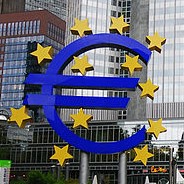
Photo: Sculpture of the euro symbol, Frankfurt, Germany (photo by Flickr user maveric2003, licensed under the Creative Commons Attribution 2.0 Generic license).
- Amid Mixed Signals From Hollande, France and Germany Drift Apart
- Strategic Horizons: Endgame Scenarios for the Syrian Conflict
- For Europe in Afghanistan, Long-term Commitment Despite Lack of Interests
- World Citizen: In Spain, a Turn to 'None of the Above'
- As U.S. Pivots, Britain Hedges Its Military Bets