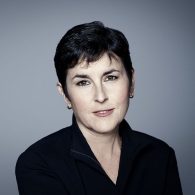
Frida Ghitis

Frida Ghitis is a world affairs columnist, author and consultant.

She started her career at CNN, where she worked initially as a show producer, a unit manager for major news operations and later as a producer and correspondent covering mostly international news.

In addition to CNN, her work has appeared in the Washington Post, Chicago Tribune, Philadelphia Inquirer, NRC Handelsblad (Netherlands) and in scores of publications in the U.S., Europe, the Middle East and beyond.

Her regular column on global affairs in the Miami Herald is distributed worldwide by McClatchy-Tribune Information Services. Her weekly WPR column, World Citizen, appears every Thursday.

She has worked in all corners of the world, traveling in Iraq during and after the rule of Saddam Hussein. She worked in Saudi Arabia, Jordan and Egypt during Desert Storm. She covered the wars in Bosnia and Kosovo, and has worked independently in Tibet, Burma, Kuwait, Argentina, Cambodia, Colombia, and dozens of places in between. Her work has taken her to the Amazon jungles of South America, to Russia, Brazil, India, Somalia, and elsewhere.

As a consultant, she advises organizations operating or contemplating projects in diverse regions of the world, providing political analysis and forecasting.

She is a public speaker on world affairs and the author of "The End of Revolution: A Changing World in the Age of Live Television."

Articles written by Frida Ghitis

World Citizen: In Spain, a Turn to 'None of the Above'

By Frida Ghitis
, on , Column

The people of Spain are now living through the fifth year of a deep economic recession, experiencing a level of unemployment that would have seemed inconceivable before the bottom fell out. But despite countless protests and furious debate, the Spanish are becoming disillusioned with all the options before them. As the recession lingers and the hardships intensify, the answer increasingly is “none of the above.” more

World Citizen: Israel’s Syria Strike Reflects Favorable Cost-Benefit Calculus

By Frida Ghitis
, on , Column

When Israeli missiles struck Syrian facilities on May 3—an operation that Israel has not officially confirmed but is widely believed to have carried out—they showed the results of a cost-benefit analysis whose arithmetic yields clear results. Since the attack, Israel has worked to assure Damascus that it has no interest in becoming embroiled in the Syrian civil war; the attack, rather, targeted Hezbollah. more

World Citizen: In India, Corruption Moves to Top of the Agenda

By Frida Ghitis
, on , Column

India’s May 2014 general election will focus, as it always has, on the need to fight poverty, reduce inequality and foster economic growth. And yet, more than ever before, the issue of corruption will play a pre-eminent role in guiding the voters’ decision. That’s because the Indian people are gradually but decisively coming to believe that endemic corruption is one of the greatest obstacles in their path. more

World Citizen: From Chechnya to Boston, a Weak Ideological Link

By Frida Ghitis
, on , Column

When authorities revealed that the suspects in the Boston Marathon bombings, Tamerlan and Dzokhar Tsarnaev, were of Chechen origin, the news might have put a smile on Vladimir Putin’s face. After all, the Russian president might have concluded, a terrorist attack by Chechens in America would vindicate his hard-line approach to Chechen rebels. The evidence so far does not support that view, however. more

World Citizen: A Turning Point for Venezuela, a Perilous Test for Chavismo

By Frida Ghitis
, on , Column

Few people expected Venezuelan opposition leader Henrique Capriles to defeat Nicolas Maduro, the late Hugo Chavez’s chosen heir. But the close election results still managed to stun. The opposition is demanding a recount, and Maduro has emerged surprisingly weakened despite his victory. It is a risky turning point for the country, a challenge to Maduro’s untested skills and a perilous time for Chavismo. more

World Citizen: ‘First Do No Harm’ Key to Obama’s Israeli-Palestinian Plan

By Frida Ghitis
, on , Column

The Arab-Israeli conflict has never lost its power to conjure visions of Nobel Peace prizes among world diplomats, even as it has repeatedly thwarted their efforts. Despite the occasional success, well-intentioned plans have also backfired disastrously, triggering new violence. As the Obama administration launches a new push for peace between Israelis and Palestinians, the watchword must be, “First, do no harm.” more

World Citizen: Iran Crisis Increasingly Tied to North Korea

By Frida Ghitis
, on , Column

When North Korea detonated a nuclear device in February, U.S. Secretary of State John Kerry drew a link between Pyongyang and Tehran, suggesting Iran would draw conclusions about its own nuclear program from how events unfolded. But it is likely that the impact of the North Korean situation on the conflict with Iran is more direct than “learning lessons” -- the two appear to be cooperating directly. more

World Citizen: Can Jordan Find a Way to Peaceful, Successful Reform?

By Frida Ghitis
, on , Column

Two years after the start of the Arab Spring, Jordan’s King Abdullah II has launched what he says is a third way. His approach, the king maintains, will bring peaceful democratic change, empowering the people and modernizing the country, while averting chaos and preventing extremist parties from emerging victorious. It’s a tall order, and one that has met with doubt among many skeptics and critics. more

World Citizen: Measuring Obama’s Success in Israel

By Frida Ghitis
, on , Column

From the moment President Barack Obama’s trip to Israel was announced, the administration undertook a systematic effort to lower expectations. On that count, the president’s trip succeeded before it started. Practically no one expects the visit to achieve any kind of a historic triumph. Given the deliberately minimized ambitions, how will we know if this much-anticipated tour was worth the president’s time? more

World Citizen: This Time, Iran Taking No Chances on Presidential Vote

By Frida Ghitis
, on , Column

With less than 100 days left until Iran holds presidential elections, the field of candidates remains surprisingly unclear. The regime is taking pains to make sure there is no repeat of the 2009 fiasco, when a strong reformist movement challenged the official results. Now it is all but certain that the June 14 polls will produce a conservative loyal to the regime and the supreme leader, Ali Khamenei. more

World Citizen: India Walking Tightrope on Iran, Israel and U.S.

By Frida Ghitis
, on , Column

India’s historical non-alignment policy has often left it standing between opposing camps, trying to keep from becoming entangled in the disputes that divide them. However, in today’s world, staying out of international conflicts is especially challenging. That is most evident as India tries to maintain its trade ties with Iran, while expanding its commercial and strategic links with the U.S. and Israel. more

World Citizen: Israel’s Netanyahu Outplayed by His Rivals

By Frida Ghitis
, on , Column

With the clock ticking on the deadline to form a governing coalition following Israel’s Jan. 22 elections, Israeli Prime Minister Benjamin Netanyahu is struggling to put together an alliance that would add up to a majority in the new parliament. There is little doubt that he will ultimately succeed and remain prime minister, but the process has been a humbling one for a man not known for modesty.

more

World Citizen: Latin America’s Leftists Audition to Succeed Chávez

By Frida Ghitis
, on , Column

Venezuelan President Hugo Chávez returned home Monday after 10 weeks of cancer treatment in Cuba. Still, many believe Chávez has come home to die. The prospect that Chávez will soon leave his position as the most prominent leftist leader in Latin America has triggered a race to fill his revolutionary boots. But his would-be successors are finding that the Chávez message does not resonate the way it once did. more

World Citizen: Suddenly, Hard Times for the Muslim Brotherhood

By Frida Ghitis
, on , Column

The early contests for power following the Arab uprisings proved rather easy for the Muslim Brotherhood. What has come since then, however, has been much more challenging. Where the Brotherhood has not won, it is facing reversals. Where it did come to power, its leaders are finding that governing, and even keeping a country from going off the rails these days, is far more complicated than winning elections. more

World Citizen: Can Fernandez de Kirchner Control the Narrative in Argentina?

By Frida Ghitis
, on , Column

With middle-class dissatisfaction growing, President Cristina Fernandez de Kirchner is finding the crucial challenge of controlling the political narrative in Argentina increasingly difficult, and she may not be able to pin the blame for her country’s woes on outside forces for much longer. That’s a key part of the strategy that has proved so effective for more than a decade of Kirchner administrations. more

World Citizen: Qatar’s Risky Bet on the Muslim Brotherhood

By Frida Ghitis
, on , Column

One of the most intriguing aspects of the new political dynamics of the Arab Middle East is the decision by Qatar to throw its full support behind the Muslim Brotherhood in the contest for the future of the region. The choice by a monarchy to support a populist movement always looked like a gamble. But now, two years into what some still call the Arab Spring, the bet by Qatar’s emir looks riskier than ever. more

World Citizen: Israeli Left Wins Hearts and Minds, but Not Votes

By Frida Ghitis
, on , Column

The Israeli left has faced a tough road for many years, unable to capture power in a system developed by the left’s own founders. In recent years, a growing consensus among foreign observers held that Israelis have taken a giant step to the right. Some had argued that the sidelining of the left indicated a radical departure in ideology for the country as a whole. The reality, however, is quite different. more

World Citizen: Anti-Semitic Rants Pull Back the Curtain on Egypt’s Morsi

By Frida Ghitis
, on , Column

Egyptian President Mohammed Morsi’s efforts to portray an image of moderation for himself, for the Muslim Brotherhood and for Egypt under the Brotherhood’s rule threaten to come undone once again. Video clips of Morsi making anti-Semitic statements, which surfaced earlier this week, carry major political repercussions and constitute a foreign policy challenge to the international community. more

World Citizen: Will Venezuela-Iran Links Survive Chávez?

By Frida Ghitis
, on , Column

During almost 14 years in office, Venezuelan President Hugo Chávez has tried at every step to antagonize U.S. goals and undermine Washington’s influence. Perhaps the greatest irritant of all was the close relationship he forged with Iran. The question for Washington now is how to maximize the chances that once Chávez leaves the scene, the ties linking Caracas and Tehran will fade. more

World Citizen: At Long Last, Mexico's Bright Future

By Frida Ghitis
, on , Column

Mexico has long suffered from a combination of problems, some of which produced bad press along with a hard-to-erase negative image. The problems have been real, but the reality is more nuanced, and much less dark. In fact, Mexico stands poised to take a leap of prosperity -- as long as its new president, Enrique Peña Nieto, manages to harness the favorable conditions the country currently enjoys. more