Articles written by David Axe
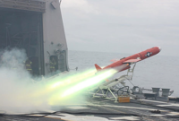
NATO's recent intervention in Libya marked the major combat debut for the U.S. Navy's growing arsenal of unmanned vehicles. In coming years, the U.S. Navy could add hundreds of flying, swimming and diving robots to its existing fleets of surface warships, submarines and manned aircraft. But the Navy's robotic revolution is a belated one. more
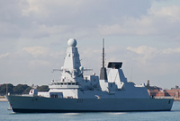
The British navy will suffer deep budget cuts as part of government-wide austerity measures, with around one-quarter of the fleet to be decommissioned and future purchases delayed and reduced. The need to give up some of its 11 current
standing missions will likely force the navy to limit its participation in multilateral naval missions, representing a major reversal for a navy that has prided itself on its international leadership role.
more
On Oct. 19, the U.K. Ministry of Defense announced its long-awaited Strategic Defense and Security Review. Though Royal Navy observers expected to lose
ships, few expected cuts as deep as those announced. The end result is a much smaller fleet and a
net reduction in the U.K.'s ability, in the medium term, to influence
world events. The implications are enormous for Great Britain and the
world. more
KINSHASA -- Congo's worsening epidemic of sexual violence could cause anarchy to spread into neighboring states, severing
commercial links and leaving much of the world without vital minerals.
Fearing this and the awful spectacle of a nation overrun by rapists, aid
groups and armies have launched a loosely coordinated campaign to help rape victims and to reform the groups responsible
for rape. more
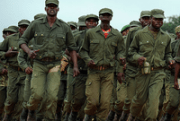
DUNGU, Democratic Republic of Congo -- Around 15,000 women and girls are reported raped in Congo each year, with thousands more likely going unreported. Rebels account for a
third of the assaults; the majority are perpetrated by Congo's own
army. Fearing the massive human and economic cost of the sexual violence, a coalition of aid groups and agencies is working to treat both
the effects and causes of rape.
more
DUNGU, Democratic Republic of Congo -- A contingent of Indonesian army engineers are hacking their way slowly through the Congolese tropical forest, while miles away, their Nepalese counterparts advance at a
similar pace. Sometime in the next couple months,
the road segments will meet, allowing U.N. soldiers
and aid workers to speed between two major eastern towns
without resorting to costly air transport. more
DUNGU, Democratic Republic of Congo -- Last week, residents of the Congolese town of Duru told peacekeepers at a
nearby U.N. base that the Ugandan Lord's Resistance Army rebel group had
just attacked and abducted several people -- right under the noses of U.N. troops. The incident highlights the difficulties the
U.N. faces in protecting civilians from one of the world's
most brutal armed groups.
more
KINSHASA, Congo -- The U.S. Army came to Congo in part to win hearts and minds. But a recent attempt to provide basic medical services in concert with the Congolese army highlighted logistical and public-relations challenges that have cropped up repeatedly since U.S. Secretary of
Defense Robert Gates emphasized the need to strengthen the U.S. military's capacity to use soft power three years ago.
more
In this four-part video opinion series, WPR contributor David Axe examines obstacles to NATO and U.S. victory in Afghanistan. These include terrain, a culture of corruption, the agrarian nature of the economy, and the technology employed by U.S. and NATO forces, he argues.
more
Since the early years of the Iraq war, insurgents have combined
civilian and military technology to
create lethal weapon systems against which U.S. forces have few
defenses. Indeed, this ability to adapt quickly is a major advantage of insurgencies in Iraq,
Afghanistan and all over the world. Now, to counter its enemies' rapid
adaptation, the U.S. Army is increasingly trying to think like an
insurgent. more
Torrential monsoon rains since late July have flooded Pakistan's Swat
Valley and portions of neighboring Afghanistan, killing nearly 2,000
people and displacing around 2 million. Relief efforts have included
deployments of troops and helicopters by the Pakistan military, the NATO
force in Afghanistan and, perhaps surprisingly, the nascent Afghan air
corps. more
Today, the
U.S. Navy is scrambling to preserve its dominance of the western
Pacific in the face of a rising Chinese military. But the emerging
AirSea Battle doctrine -- inspired by the 1980s' AirLand doctrine -- risks foundering for a lack of cash and hardware.
U.S.-allied governments that could help compensate for America's waning
resources might be turned off by AirSea Battle's risky aims and
aggressive overtones. more
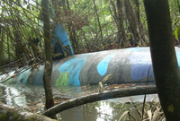
It was a shocking discovery. On July 2, agents from the Ecuadorian
military and police raided a smugglers' camp deep in Ecuador's jungle. Among rickety
buildings and some scattered equipment lay a 100-foot-long submarine,
half-submerged in a muddy channel. Smugglers have
been using semi-submersible boats for more than
a decade, but the fully submersible Ecuadorian vessel is the first of
its kind known to authorities. more
Fifteen days after twin suicide bombings killed 76 people in Kampala,
Uganda, President Yoweri Museveni used an African Union summit in the
capital city to declare war on the Somali group responsible for the July
11 bombing -- as well as on foreign fighters aiding the group. But to secure its borders, cities and
regional interests, Uganda must do more than target terrorists.
more
One of U.S. Army Gen. David Petraeus' first moves after taking command
of the war effort in Afghanistan was
to begin forming
"community policing units" to help bolster local security in
Taliban-plagued areas. Reaction to the plan was swift and
alarmed. On no fewer than three occasions in the last three
years, NATO has experimented with local security forces.
All these previous efforts failed, sometimes spectacularly. more
In the
July issue of the U.S. Naval Institute's Proceedings magazine, an officer of the Indian navy claimed that
Islamic extremists had teamed up with sea pirates in Somalia to form a
"nexus of piracy and terrorism." In reality, where Somalia's Al-Shabab and other Islamic groups control territory,
pirates are usually among the first targets of the groups' emphasis on
law and order. more
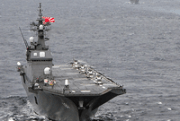
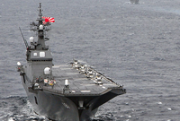
On a number of recent occasions, unannounced Chinese naval flotillas cruised in international waters off the coast of Japan, in contravention of naval protocol if not of international law. The incidents seem to portray China as a maritime
aggressor among nations apparently unprepared to counter any move by Beijing. But Japan is quietly enhancing military capabilities
that themselves pose a threat to the fast-growing Chinese navy.
more
When hundreds of thousands of Darfuri refugees flooded across the
Chad-Sudan border in 2003, the
U.N. and various aid groups raced to help, building a vast network of refugee
camps. But armed groups waging battle with Khartoum and its militias used the camps
as safe havens and recruiting pools. Inadvertently, the U.N., EU and
aid groups had taken a side in one of the world's worst conflicts,
thereby prolonging it. more
In February 2008, the government of East Timor declared a
state of emergency after rebels under disgruntled former army officer Alfredo Reinado tried to assassinate the country's president and prime minister. Today, East
Timor faces a new and more welcome set of challenges: negotiating
potentially conflicting efforts by world and
regional powers to gain influence in the still under-developed country. more
In April,
the U.S. Air Force's X-37B prototype roared into orbit atop a rocket
launched from Cape Canaveral in Florida. Some 15 years in development,
the X-37's technology, performance and purpose all are cloaked in
mystery. Two months after the unmanned vehicle's launch, it is still in
orbit, performing its unspecified tasks behind the military's veil of
silence and ambiguity. That has caused concern among potential rivals of
the U.S. more