
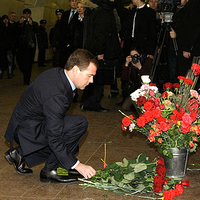
Last month's terrorist bombings of the Moscow Metro along with other indicators of surging Islamic-inspired violence in southern Russia suggest that the Kremlin has yet to overcome longstanding Muslim hostility to Moscow's control of the North Caucasus. Although the Russian federal government adopted a new strategy a year ago that might eventually overcome some persistent problems, the Moscow massacre risks triggering another wave of escalating reciprocal violence.
Throughout the past year, the North Caucasus republics of Chechnya, Dagestan, and Ingushetia have experienced increasing terrorist violence (.pdf). In Chechnya, for example, the number of violent deaths nearly doubled in 2009 compared with the figure for the previous year. The killings of political leaders, police officers, human rights activists, and journalists throughout the North Caucasus have confirmed the rising tide of Muslim militancy. In claiming credit for the Moscow Metro bombing, Islamist leader Doku Umarov vowed that his forces would continue the attacks until Russia withdrew from what he called his "Caucasus Emirate," under which he also included the North Caucasus republics of Kabardino-Balkaria and North Ossetia.
The surge of Islamist-linked violence in the republics of the North Caucasus can be traced back to the end of the Soviet era, when Moscow temporarily lost control of Chechnya and other Muslim-majority regions, but the recent resurgence is due to later developments. The 1994-96 Russian war with Chechnya established conditions favorable for radical Islam to take root in that republic, while also creating the foundation for broader problems. Even if the war was primarily couched in nationalistic terms, Islamic extremists were able to exploit Russian military attacks to propagate their vision of an Islamic state under Shariah rule, which would encompass the entire North Caucasus.