
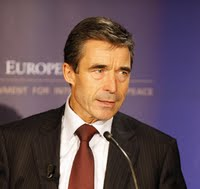
In his first major speech as the alliance's new civilian head, NATO Secretary General Anders Fogh Rasmussen told an audience in Brussels that the time had come to revitalize security ties between Moscow and the Western alliance. Reflecting the speech's hopeful title, "NATO and Russia: A New Beginning," Rasmussen identified several possible areas for deeper collaboration. But the most newsworthy focus of his presentation was on ballistic missile defense (BMD).
Rasmussen's remarks came on the heels of U.S. President Barack Obama's announcement the previous day that his administration would suspend the U.S. missile defense systems planned for Poland and the Czech Republic. Not surprisingly, Rasmussen deliberately sought to build on the momentum Obama's decision had created toward improved East-West relations. For the past two years, Russian political and military leaders had waged a campaign of threats and denunciations against the United States and other NATO countries in opposition to the intended deployments. Although the indefinite postponement of the installations may now offer opportunities for improved NATO-Russian security cooperation, thus far Moscow's only concession has been to announce the cancellation of its threats to place Iskander short-range ballistic missiles in Russia's Baltic enclave of Kaliningrad.
Describing the proliferation of ballistic missiles as a threat to Russia as well as to NATO countries, Rasmussen called for joint exploration of "the potential for linking the U.S., NATO and Russian missile defense systems at an appropriate time." Although Rasmussen declined to describe how this integration might occur, he added, "Both NATO and Russia have a wealth of experience in missile defense. We should now work to combine this experience to our mutual benefit."