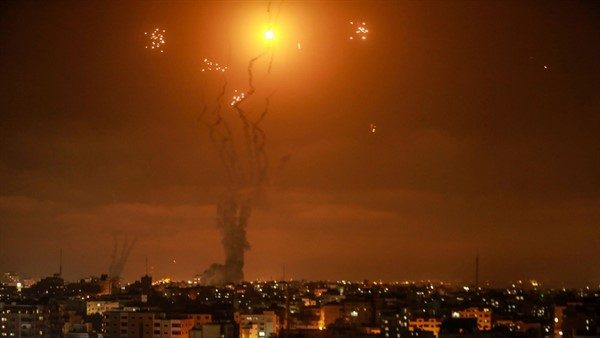
Although Israel’s Iron Dome missile defense system intercepted its first missile in April 2011, it officially came of age last November during Israel’s Operation Pillar of Defense, the latest iteration of the conflict between Israel and Hamas in Gaza. Of some 500 Gaza-fired rockets and missiles that Iron Dome’s radar identified as likely to hit populated areas, as opposed to falling into the sea or open fields, about 420 were shot down, for a success rate of 85 percent. In the process Iron Dome provided the majority of Israel’s population with a deep sense of security: Though they were being targeted by Palestinian fire, Israelis felt an effective countermeasure was in place to protect them.
In the weeks since the most recent round of hostilities ended, the Iron Dome system
has received nothing but high praise. Hailed as a product of “Jewish genius,” the “one clear winner in the latest round of hostilities between Israel and Hamas” and a “
military revolution,” the system is reportedly now being considered for purchase by numerous governments, including South Korea, Singapore and Turkey. But if the technological breakthroughs and military advantages gained in fielding the system in a relatively short time have rightly attracted attention, other issues have been ignored.
First, Iron Dome cannot address the threats it was initially designed to counter: mortar and artillery shells as well as very short-range rockets, such as the Qassam, used by Palestinian militants. It was primarily these types of weapons that plagued the populated areas of southern Israel in the months and years before Operation Pillar of Defense, and the only two Israeli military casualties in the recent operation were due to such rocket fire. Moreover, the various Palestinian factions inside the Gaza Strip will continue to use small, short-range weapons like the Qassam. Though they carry small warheads and are very inaccurate, these projectiles are cheap and simple to manufacture and easy to hide, transport and operate. Existing systems for addressing this threat, including ones using chemical lasers and Gatling guns, were dismissed by the Israeli Ministry of Defense in favor of Iron Dome.
Second, Iron Dome cannot deal with large quantities of the projectiles it is most effective against. During Operation Pillar of Defense, some 1,500 mortars and rockets -- around 100-120 per day -- were launched from Gaza and tracked by the system. Any significant increase in that number would overload the system in several ways. First, there would be too many targets for the radar to track. Second, there would not be enough Iron Dome batteries to cover the entire country. And third, there would not be enough interceptors in each battery. Increasing the number of batteries and interceptors in the inventory -- as Israel intends to do, with financial support from the United States -- will alleviate this shortfall. But potential future conflicts, for example ones involving Hezbollah, Syria and Iran, would likely involve thousands of mortar rounds, rockets and missiles fired on Israel every day over the course of weeks. Most of Israel’s neighbors possess the capability to build and operate such weapons in bulk. In the future, even a 95 percent success rate for Iron Dome could still allow such missile strikes to exact a heavy toll on Israel.
Finally, the success of Iron Dome was not only a result of its superior design and the skill of its operators; equally important was the introduction of more-advanced rockets into the region. For years, Hamas and other militant groups in the Gaza Strip have been equipping themselves with medium-range Grad and Fajr rockets that have larger warheads and greater accuracy and range -- the former of 12-20 miles, the latter of 30-50 miles. Supplied mainly by Iran, which for years has been manufacturing and stockpiling its own mortars, rockets and missiles in large quantities, these medium-range rockets do not need to be fired from locations close to the border with Israel, making them harder for Israeli forces to detect and destroy on the ground. Instead, Grads and Fajrs are launched closer to the border with Egypt, a safer distance for operators. Ironically, this has been an advantage for Iron Dome, as bigger rockets make for bigger targets and longer flight times, even if by only a few seconds, meaning more time for countermeasures to engage.
There is no “one size fits all” solution in missile defense. Only a layered and integrated system-of-systems can detect, track and engage all types of incoming projectiles. Israel recognizes this, and Iron Dome is not the only weapon in its missile defense arsenal. For the past several years, Israel has been investing heavily -- again with generous U.S. funding -- in systems that address the threats of long-range rockets and ballistic missiles: the David’s Sling and Arrow systems, respectively. And for the threat of medium-range rockets, Iron Dome is now a proven solution.
However, two threats remain unanswered: that of mortars, artillery rounds and short-range rockets, all of which are readily available to Israel’s enemies, and that of multiple launches concentrated on a single target. Countermeasures to both threats exist now, and emerging technologies promise even better ones. Israel must recognize that the success of Iron Dome was a result of the limited scope of the latest round of hostilities, and embrace a broader and better-integrated set of defensive solutions to prepare for future conflicts that may not be as constrained.
Guy Ben-Ari is a deputy director and senior fellow at the Defense-Industrial Initiatives Group at the Center for Strategic and International Studies.