
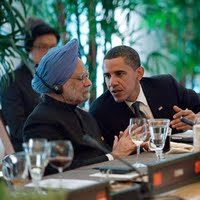
Beginning with the George W. Bush administration, the U.S. strategic policymaking community has expressed its desire to support India’s emergence as a great power. However, the very fact that these exhortations must be made from time to time reveals the distance the world’s two largest democracies must still travel to truly understand each other. The U.S. continues to struggle with India’s non-alignment impulses, while India continues to see relations in a globalized era as depending on balance of interests, and not balance of power.
Indeed, it is this differing approach to globalization that prevents the two countries from fully consolidating bilateral relations. Globalization during the post-Cold War “end of history” moment coincided with a planet-wide examination of essentially Western views on governance and economics. However, the financial crisis in the West and the near-simultaneous resurgence of China and India has put paid to any single globalization narrative. In the case of India in particular, many Western observers interpret New Delhi’s behavior as a reflexive quest for strategic autonomy. To do so, however, is to ignore the numerous areas where U.S. and Indian interests diverge.
Nowhere is this more apparent than with regard to Iran. For Indian planners, Iran is critical for energy security at a time when the Indian economy is having difficulty balancing inflation caused by imported energy with the need to promote private investment. Moreover, India’s large refining capacity is optimized for Iranian crude, and switching over to another blend will be costly. In any case, as a large net importer of energy, India has an interest in maintaining diversified sources of supply. Of course, India does share Washington’s concerns over Iran’s nuclear program, as evidenced by its two votes at the International Atomic Energy Agency to refer the matter to the U.N. Security Council.