
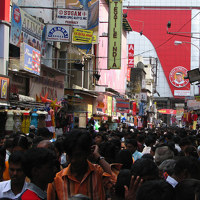
When most people think of revolutions, they imagine the overthrow of political orders. By contrast, most of what we see today in globalization’s continued expansion is not violent political revolution, but rather unsettling socio-economic revolution. Yes, when existing political orders cannot process that change -- and the angry populism that typically accompanies it -- they can most definitely fall. This is what we have seen in the Arab Spring to date. But more often this populism leads to political paralysis in countries both democratic and authoritarian. A case in point is the recent controversy in India over Prime Minister Manmohan Singh’s plan, since scrapped, to allow multinational retail chains like Wal-Mart, Carrefour and Tesco to mount joint ventures with local firms in direct retail sales operations. The public uproar showed that at times, globalization is simply too much change, too fast.
It does not have to be that way, especially in an economy with sufficient job creation and labor mobility. A successful example of just such a small-world revolution took place in my hometown of Boscobel, Wisconsin, during the 1960s and 1970s. Boscobel was then a small town of just more than 2,000 inhabitants, but it was the commercial hub of a much larger farming region, many of whose townships were home to populations of less than 200. So compared to them, Boscobel was a bit of a magnet, despite having only a couple local franchises of national retail chains.
What happened across those two decades? When I started kindergarten, roughly half of my fellow students lived on farms. But by the time I graduated from high school, the “farm kids” had become a small minority. The shift was driven by agri-businesses that moved in and bought up most of the family farms. With the displaced farming families pushed into towns like Boscobel, local service jobs became highly valued, as blue- and white-collar jobs often required long commutes to even bigger towns located near interstate highways. Those who made those commutes, like my mother, began to start regularly shopping at big-box retail stores, further diminishing the revenue of the “mom and pop” stores that once defined Boscobel’s economic landscape.