A $61 billion aid package to help Ukraine was finally passed in Congress and will be signed into law. But questions still linger over Washington’s ability to act as a reliable partner to its friends and a determined adversary to its foes.
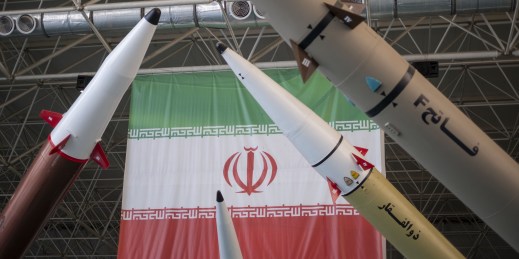
More than a week later, there remains considerable uncertainty about Iran’s unprecedented attack on Israel using its long-range strike capabilities. As more information becomes public, it is important to be mindful of three important considerations to understand the attack’s implications on military dynamics across the Middle East.
While efforts by the U.S., European Union and China dominate the coverage around how to regulate artificial intelligence, a less-publicized but vital discourse about AI is taking place throughout Africa, Aubra Anthony and Jane Munga report in their in-depth piece for WPR.
In a flurry of recent activity around AI, including industry conferences, startups, community initiatives and national policy proposals, the continent’s governments and citizens are acknowledging the significant societal consequences that AI will have, while signaling their determination that AI—and its governance—be shaped by those it affects.
And while policymakers in the Global North work to solve thorny problems of risk mitigation for frontier AI models to ensure that AI is safe, most African policymakers face another challenge: how to responsibly leverage AI to accelerate national development.
Key insights into the African AI discourse from Anthony and Munga:
AI is seen as a tool for achieving national development. African policymakers primarily see AI as a tool for achieving national development goals and economic growth. AI is framed as an amplifier of digital transformation and a pathway that can help lead to solutions to persistent development challenges. To level the global playing field, African policymakers often want to mitigate barriers to AI’s deployment.
There is an urgency to develop AI enablers. AI’s impact has been most visible in countries with advanced technology infrastructure and especially computing power. AI-enabled services require physical infrastructure like data-storage centers and fiber cables. And in a continent that is “mobile first,” cell towers are necessary to enable data flows and connectivity. Across Africa, there is an urgent need to build out this infrastructure, given the stubborn digital divides that remain in place.
Africa’s innovative youth are impatient. They want to bring AI’s many benefits to bear on the continent’s most pressing problems and promising opportunities. Over half of Africa’s population is under 25 years old, and many young people lack employment. The political pressures of responding to these needs help explain African policymakers’ emphasis on AI as an economic opportunity.
But African policymakers have not ignored the potential risks. Given AI’s potential to cause harm, policymakers have rightly begun to note that promoting more ethical, representative AI is a necessary complementary goal to pursue. Rwanda’s policy, for instance, places practical AI ethics and guidelines alongside the development of digital skills and build-out of reliable infrastructure and computing capacity.
For their part, AI actors in the Global North see the potential of the countries of the Global South as frontier markets, but also recognize they wield growing political power to block or expedite their ambitions.