
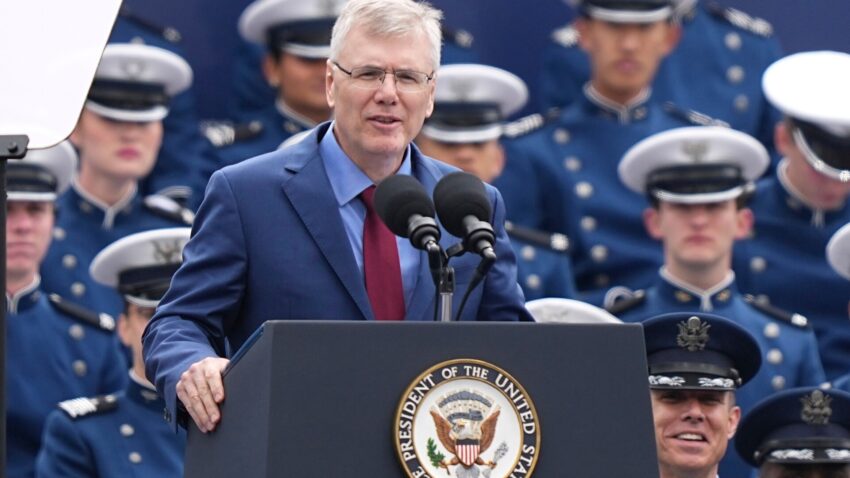
Air Force Secretary Troy Meink announced yesterday that the U.S. has deployed space-based weapons, marking the first-ever such acknowledgement by Washington. In a keynote speech at a privately organized conference, Meink said the U.S. military’s Space Force branch “now has on-orbit space control weapons capable of defending the joint force against hostile adversary action.”
In a Q&A session following his speech, Meink refused to add more precision about the type of weapon, stating only that his remarks were intentional and the phrasing “very well thought out” to establish deterrence among America’s rivals. But given Washington’s longstanding aversion to creating massive debris clouds that would also threaten U.S. space assets, most observers assumed he was referring to space-based electronic jamming capabilities, which would allow the U.S. to “silence” enemy satellites without destroying them.
The move, and the public acknowledgement of it, follows years of reports that Russia has been increasing its own space-based offensive capabilities, including orbiting “satellite-killers” and even—according to U.S. lawmakers and officials—nuclear-armed satellites. The latter would violate the Outer Space Treaty’s ban on space-based nuclear weapons, though the pact allows for conventional weapons in orbit. However, even conventional anti-satellite capabilities are considered destabilizing to nuclear deterrence, given the role played by satellites in both tracking incoming attacks and guiding any second-strike ripostes.