Peter Kiernan is a freelance writer on the international politics of energy, Middle East politics, and U.S. Middle East and energy policy. He has a Master's degree in International Political Economy and Development from Fordham University in New York and, following a stint as an energy journalist at Energy Intelligence, works as a Middle East and energy analyst at AALC, a business consulting firm in the Washington, D.C., area. In addition to World Politics Review, he has been published in several international affairs journals and newspapers based in the U.S., U.K., and Australia.

Articles written by Peter Kiernan
The Nabucco project gained some momentum in mid-July with the signing of an inter-governmental agreement between countries involved in the natural gas pipeline proposal. If completed, the pipeline would unlock reserves from the Caspian region and potentially the Middle East, thus providing the European gas market with sources of supply outside of Russia.
more
With events still unfolding inside Iran, it is not yet clear how things will pan out for the Islamic Republic, which now faces its greatest challenge since the regime's early revolutionary days. But the reverberations of Iran's internal tumult are potentially far-reaching: the entire world is now observing developments closely to see how the Middle East power's internal ructions might impact their own strategic interests. more
A second four-year term for Iranian President Mahmoud Ahmadinejad is a setback for the Obama administration, presenting difficulties for any U.S. attempt to diplomatically engage Tehran. Although a reformist victory would not have guaranteed a thaw in U.S.-Iranian relations, it would have made engaging Iran an easier political sell, both in Washington as well as among European and Arab allies.
more
On Friday, Iranians will go to the polls to elect the president of the Islamic Republic to a four-year term. Hardline President Mahmoud Ahmadinejad is the candidate to beat, but an intriguing struggle has taken shape in the last few weeks of the campaign. Should Ahmadinejad be defeated, it will be the first time that an
incumbent president has been voted out of office in the Islamic
Republic's history. more
President Obama has changed the tone of the U.S.-Russia relationship, reducing mutual distrust and bitterness. However, although energy is not a major part of the
public discourse on U.S.-Russian relations, it is a latent factor that
will remain a theater for strategic competition between Russia and the
West. The Obama-Medvedev meeting during the London G-20 summit did nothing to alter this. more
President Obama has a huge task ahead of him should he attempt to break the
30-year American-Iranian deadlock. For rapprochement to
work, a lot depends on how both sides approach it. Three decades of
mistrust won't be broken down easily or quickly. The following are
guidelines that the Obama administration should consider when it
formulates its approach to the Islamic Republic. more
While control over routes for the export of oil and gas to
Western markets was clearly not the primary cause of the recent
hostilities between Moscow and Tbilisi, the vital role of the Caucasus
as an energy transit route nevertheless cannot be ignored in the
context of Russia's increasingly tense relationship with the United
States and its European allies. The recent
conflict in Georgia demonstrates that the virtual free ride the United
States has had in the region during the last two decades is now over.
more
Earlier this month, Royal Dutch Shell and Spain's Repsol pulled
out of a proposed Iranian natural gas development project that was
estimated to be worth over $10 billion. The decision by the two
European energy firms
was seen as a setback for Iran's efforts to court foreign interest in
its energy sector at a time when the Bush administration is actively
trying to discourage it. But now Iran's huge natural gas reserves are getting much greater attention
from Asian energy-consuming nations. more
Given the projected robust growth in China's oil consumption over
the next few decades, it will increasingly view the Middle East as a cornerstone of its
energy security interests. The fact that China
is now an aggressive player in the quest for global energy supplies has
caused concern in the West, which worries that China seeks to challenge the United States' dominant
security role in the Middle East. Is conflict between the U.S. and
China over Middle Eastern energy resources inevitable?
more
Energy independence has emerged as a popular rallying cry in this
U.S. election year. Democratic and Republican presidential hopefuls all
at some stage have advocated energy independence, especially independence from foreign sources in the Middle East. While
convenient to advocate in an age of sound-bite politics, energy
independence is in fact not possible to secure in the United States in
the foreseeable future, and is of doubtful utility in any country that
might be in a position to achieve it. more
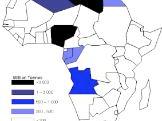
Earlier this year, crude oil imports from sub-Saharan Africa to the United States
briefly surpassed those from the Middle East. Africa has become strategically more important for the United
States in recent years and the growth of African energy supplies is one
reason why. Even so, the Middle East remains the world's largest source of oil, and thus, given the fungible nature of the oil market, will remain of prime strategic importance even if the United States is able to significantly reduce its dependence on Mideast oil.
more
The standoff
over the Islamic Republic's nuclear program has prompted
speculation about the significance of the "oil factor" in Iran's
domestic politics and in its relationship with the outside world. Is
Iran importing gasoline because it is running out of oil? Do the fuel
riots in Iran earlier this year mean that sanctions against Iran are
working? Would Iran use the oil weapon? Can the oil weapon be used
against Iran? These questions are crucial, but attempts to answer
them have often been misleading.
more
While the Bush administration's efforts to contain Iran have
found some resonance with the region's Sunni Arab political
establishment, a recent survey conducted in six Middle Eastern states
reveals that the strategy to galvanize an anti-Iranian coalition has
not made an impact on the climate of opinion formed in the Arab street. Pro-Western Sunni Arab regimes, especially Saudi
Arabia, have raised concerns about rising Iranian influence, but Sunni publics do not see things the same way their leaders do, the opinion poll reveals.
more
The conventional wisdom among neoconservatives who advocated an
invasion of Iraq is that Bush administration incompetence explains what
has gone wrong. The problem, they say, lies in the execution of what
they still maintain was a noble idea: that invading Iraq would put
anti-American forces in the Middle East on the defensive and initiate
the spread of democracy. While it is convenient to lay blame entirely on the Bush
administration's implementation of its Iraq policy, it is disingenuous
to try to make such a clean distinction between an idea and its
execution. more
The United States, the world's largest oil consumer, is getting
uneasy about its steadily increasing dependence on imported petroleum.
A question increasingly being asked is whether the U.S. oil habit is
sustainable any longer. Yet as much as these questions are being asked, they have yet to make a significant impact on actual policy. One reason is that reversing the trend of growing U.S. dependence on foreign oil is much easier said than done.
more
As a fragile ceasefire teeters in Lebanon, a broad consensus among
Western analysts has emerged with the view that the Islamic Republic of
Iran is the main regional victor of the war between Israel and
Hezbollah. Certainly the fact that Hezbollah survived Israel's
one-month assault has brought strategic and public relations dividends
to Iran. Yet what is the
nature of this declared Iranian success and what are its implications? more
The crisis in Lebanon initially generated a flurry of
commentary claiming that Israel had become engaged in a conflict
against Shia Islamist radicalism, and that its intent to defeat Hezbollah had the full support of the Sunni Arab world. This rush to assign "good guy" and "bad guy" labels to Sunni and
Shia Muslims has characterized a lot of Middle East punditry for at least the last 25 years. This
commentary has been flawed and contradictory. As soon as
geopolitical circumstances change, the positive or negative labels
attributed to Sunnis and Shia are immediately reversed. more