Henry Mance


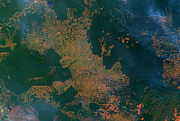
A meeting on Thursday, Nov. 26, might be the only chance Amazonian countries will have to work out a common negotiating position ahead of the
Copenhagen climate change summit next month. Perhaps reaching a regional agreement was seen as a formality. But the reality is that Amazonian countries have conflicting conservation strategies that will likely take time and effort to reconcile.
more
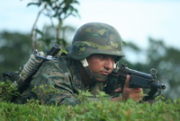
PUERTO NUEVO, Ecuador -- From a helicopter transporting 24 Ecuadorian troops towards the Colombian border, the Amazonian jungle appears undisturbed but for the odd farm or oil well. But under the foliage, invisible from the air, are FARC guerrilla bases and cocaine laboratories. The soldiers' mission over a five-day patrol covering around 25 kilometers will be to find and destroy them. more
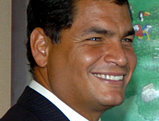
QUITO, Ecuador -- Ecuadorian President Rafael Correa resoundingly won re-election with an unprecedented first-round victory in Sunday's elections. The question now is what to expect from a new Correa administration. Over the past two years, Correa has blended revolutionary rhetoric with the capacity to surprise. But the president's campaign message left many voters uncertain about his priorities. more
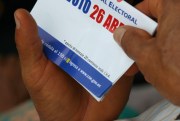
One local candidate is comparing his crime-fighting abilities to Batman's. A would-be president has promised to raise the minimum wage to $77, because seven is a good number. And the government's "revolutionary" version of the Beatle's song "Hey Jude" has incurred the wrath of the copyright administrators. Yet if Ecuador's election season seems strange, it pales in comparison to the chaos that went before. more
BOGOTÁ, Colombia -- Colombia's internal debate over a third term for President Álvaro Uribe shows little sign of being settled soon. In 2008, 4 million Colombians signed a petition that would allow Uribe to stand once again in the 2010 polls. The Colombian president has avoided stating his own position on the matter clearly. Yet the idea is facing growing opposition over the damage a second reelection would cause Colombia's institutions. more
BOGOTÁ, Colombia -- According to the U.N.'s top anti-drug
official, consumers of prohibited substances -- particularly cocaine --
might reconsider their discretionary spending habits in the midst of the current economic turmoil. Analysts, though, are less sanguine, citing the explosion in American cocaine use during the recession of the 1980s as a counterexample. Whether or not the global slowdown impacts cocaine consumption, and with it the destabilizing effects of drug trafficking, might depend on how governments adjust their drug policy spending.
more
BOGOTÁ, Colombia -- In Colombia, the recent spat between President Álvaro Uribe and Venezuelan President Hugo Chávez is bad news not only for the hostages that Chávez's mediation had aimed to free, but also for a whole range of other actors, including the country's democratic left. For decades, leftists in Colombia have had to prove their separation from the violence of the FARC. Chávez's antics have served to tar Colombia's democratic left with a second brush -- that of irresponsible Bolivarianism. more
BOGOTÁ, Colombia -- President Evo Morales wants to "refound
Bolivia." His Ecuadorian counterpart Rafael Correa wants to "correct
the barbarities committed by the party-ocracy." Their chosen method --
like Venezuela's Hugo Chávez before them -- is a new constitution. However, this focus on constitution drafting, rather than on the hard work of real socioeconomic reform and constructing political movements that are based on more than the charisma of a single leader, often proves divisive and ineffective.
more