
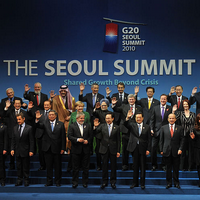
Heading into the G-20 summit in Seoul last week, tensions were visibly high between the U.S. and China, the world's top-two economies. Washington's demands that China allow its currency, the yuan, to appreciate were met with criticisms from Beijing about the Fed's inflationary monetary policy. At the heart of the argument lay global current account imbalances, largely a consequence of the sizeable U.S. trade deficit with China. By the close of the summit, the U.S. delegation succeeded in getting the Chinese to acknowledge that these imbalances were problematic for the global economy, but failed in getting them to do anything about it.
In the end, this result says less about the G-20's ability to coordinate policy than it does about the changing distribution of global power: The U.S., long able to influence the domestic economic policies of its major trading partners, now faces interlocutors that are increasingly immune to its suasion.
Current account imbalances weren't the only issue on the agenda at Seoul. Other outcomes included an endorsement of the Basel III global banking regulations, an acknowledgement that emerging-market economies should be able to use capital controls to curb speculative financial inflows, and finalization of plans to rebalance voting power within the IMF. The latter two, on balance, can be seen as a victory for the emerging-market members of the group.