
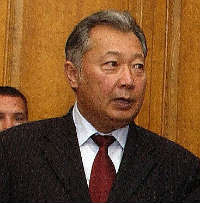
Less than a week after a small, provincial protest snowballed into a national revolution, Kyrgyzstan sits in a holding pattern. While opposition leaders now apparently occupy all the key offices in the capital, Bishkek, the country's incumbent president, Kurmanbek Bakiyev, has refused to step down, and is said to be gathering supporters in his native Jalal-abad in the south. After having spoken cordially with U.S. Secretary of State Hillary Clinton as well as with Russian diplomats, Roza Otunbayeva, leader of the interim coalition, has assumed an air of legitimacy that will be hard for Bakiyev to displace. Nevertheless, though Bakiyev is unlikely to regain his former post, how he reacts to his present situation -- whether with violence, resignation or, less credibly, a bid for some form of power-sharing -- will set the tone for the nation as it prepares to rebuild its cracked institutions.
Ironically, Bakiyev leaves the White House, as Kyrgyzstan's presidential office is called, in the same way he arrived -- by means of a popular revolt. In the wake of the 2005 Tulip Revolution -- a nonviolent "color revolution" similar to those in Ukraine and Georgia -- Bakiyev was celebrated as the reformist antidote to the increasing corruption of his predecessor, Askar Akayev. Even Otunbayeva, who may now replace him, was a Bakiyev supporter in the early days of his presidency.
It did not take long, however, for Bakiyev to veer toward autocracy. He has been quick to shut down media outlets critical of his policies, and by 2007, helped along by crooked polling and intimidation tactics, he had consolidated his power by ushering members of his newly founded Ak Zhol party into a parliamentary majority, thus weakening any legislative check on his authority. Since then, a number of his political opponents have been beaten by unidentified assailants, while others were found mysteriously killed.