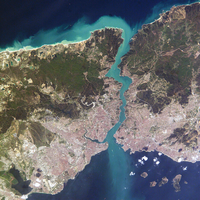
Ever since men first put to sea, conflicts have swirled around narrow maritime passages known as choke points. A subset of the broader category of Sea Lines of Communication (SLOCs), maritime choke points act as funnels drawing in shipping from surrounding seas. As critical pressure points in naval struggles for "command of the sea," every navy seeks to secure them while denying their use to the enemy. Homer's "Iliad" already detailed the epic struggle between Troy -- situated on the Dardanelles, the ancient world's leading choke point -- and a coalition of Greek city states whose armies arrived by sea from across the Aegean. About 3,000 years later, in his seminal 1890 work, "The Influence of Sea Power Upon History, 1660-1873," Capt. Alfred Thayer Mahan was the first to articulate the nexus between naval power, maritime trade and political influence. He was followed by British First Sea Lord John Arbuthnot Fisher, who before World War I first delineated the world's most important naval choke points in advocating for a strong Royal Navy to defend Britain's colonial interests. The natural choke points identified by Fisher -- besides the aforementioned Turkish Straits and Britain's primary concern, the English Channel -- included the Strait of Gibraltar at the mouth of the Mediterranean Sea, the Straits of Malacca in South Asia, the Strait of Hormuz at the entrance to the Persian Gulf, the Bab el-Mandab channel connecting the Red Sea to the Arabian Sea, and Cape Horn and the Cape of Good Hope at the southern extremities of Latin America and Africa, respectively. In the category of man-made passages, Fisher included the Panama and Suez Canals.
Naval Choke Points and Command of the Sea