
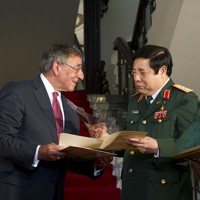
Earlier this month, Leon Panetta became the first U.S. defense secretary to visit Vietnam’s Cam Rahn Bay deepwater port since the end of the Vietnam War. He attended a ceremony at the USNS Richard E. Byrd, a cargo ship operated by a mainly civilian crew under the Navy’s Military Sealift Command, which was undergoing repairs by Vietnamese workers. Speaking on the deck of the ship, Panetta called for more high-level exchanges between the U.S. and Vietnam, as well as enhanced defense cooperation.
If Panetta chose to stop in Vietnam for a few days during his nine-day tour of Asia, it is because Vietnam and other Southeast Asian countries play a major role in the Obama administration’s Asia pivot. In particular, Panetta was there to pursue the Pentagon’s goal of making the U.S. force posture in Asia more “geographically distributed, operationally resilient and politically sustainable.” Partly due to foreign military basing constraints in Japan and South Korea, the Obama administration aims to expand defense cooperation with other Asian partners. The geographic focus of this effort has been in Southeast Asia, which complements the large, fixed U.S. bases in Northeast Asia and also provides for superior access to vital shipping lanes in the Indian Ocean and South China Sea.
So far, the functional focus of this effort has been on building the capabilities of local militaries. For example, the administration wants to enhance the air and naval capabilities of friendly maritime states so that they can help protect international waterways from pirates and other threats to freedom of the seas, freeing the U.S. Navy to focus on higher-end threats. U.S. military and civilian officials have disclaimed any interest in acquiring new permanent bases in the Asia-Pacific region. Instead, the Pentagon foresees relying on periodic forward deployments and troop rotations, joint exercises and training sessions with regional armed forces, as well as other nontraditional basing deployments.