
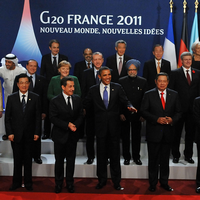
In the wake of last week's G-20 Summit in Cannes, France, a number of commentators have weighed in on the U.S. response -- or lack thereof -- to Europe's ongoing financial crisis. Most notably, articles in the New York Times and the Los Angeles Times suggested that the lack of a U.S. contribution to Europe's bailout fund is a clear sign of American decline. As further support for the "decline narrative," both trot out examples from the 1990s, when the U.S. led the way in bailing out Mexico and East Asian countries as financial crises gripped their economies.
Yet, on two counts, the analysis is flawed. First, the U.S. has in fact offered financial assistance to Europe, albeit in an under-the-radar fashion. Second, it is a mistake to compare the threat posed to the U.S. economy by Mexico in 1995 and East Asia in 1997 to that posed by Greece today. In short, the United States' prudent reaction to what is happening in Europe should not be surprising. Indeed, it is quite consistent with U.S. behavior over the past 25-plus years.
The first problem with the decline narrative is the claim that the U.S. has done nothing to aid Europe in its present crisis. In fact, since early 2010, the Federal Reserve has made an unlimited line of credit available to the European Central Bank (ECB) -- among several other foreign monetary authorities -- via a liquidity swap line. As of Nov. 2, the ECB had upward of $1.8 billion in outstanding debt with the Fed. While this is admittedly a small contribution to Europe's current troubles, it is at the moment a precautionary measure. If Greece were to default on its obligations in a disorderly fashion, the ECB's drawing from this credit line would undoubtedly increase substantially. In other words, if things get really bad, the U.S. response will increase in kind.